APW Elementary

APW Elementary
Rebel Pride Starts Inside

Wednesday, January 20, 2016

Day #81 - 1/20/16 - Drafting a Persuasive Essay, & Revising/Editing an Analytical Essay

Good Morning Sixth Graders,
         Today is an A day, so we will go to Gym. We will also be going to the lab today after we finish editing, conferencing, & revising our essays. Let's make it a wonderful Wednesday. We have the lab signed out for:
9:00 - 10:00
10:30 - 11:15
12:30 - 1:30
2:00 - 2:30
Please...
  • Sharpen your pencils
  • Order your lunch
  • Check your mailbox
  • Get your Writing folder
                                     Thank you
                                     Mr. Trumble

Point to Ponder: Please check your persuasive essay for the following. Then begin making a Frayer Poster for one of the vocab words from your guided reading book.
1. Hook
2. Introduce yourself  
3. Tell why your topic is important
4. Thesis (I believe statement)


Activity #1
Persuasive Writing with Mrs. Isham

Activity #2
Analyzing and Evaluating Harry Potter as a model of the Hero's Journey
  • Today I will use a revising and editing checklist, so that I can improve my essay showing how Harry Potter fits the pattern of the Hero's Journey. 
  1. What is the difference between revising and editing?
  2. Why should you take the time to revise your writing?
  3. How does editing affect your writing?

1st - Revising
Revise by yourself first, then revise with a  partner.
If you are struggling, use this pattern to help you evaluate your body paragraphs. Each body paragraph should have all these parts.
Analytical Essay 
(One type of Pattern for your Writing)
  • 1. Intro sentence
    • Ex: Harry Potter receives a call to adventure.
    • Ex: Harry has allies and helpers that assist him along the Hero's Journey.
  • 2. Sentence describing the stage of the Hero's Journey.
    • Ex: According to the Hero's Journey....
  • 3. Sentence about your detail
  • 4. Sentence explaining your evidence
    • In the text it says...
    • According to the Author...
  • 5. Sentence connecting your detail and evidence. 
    • Ex: This shows...
    • Ex: This evidence proves...
    • Ex: This demonstrates how...

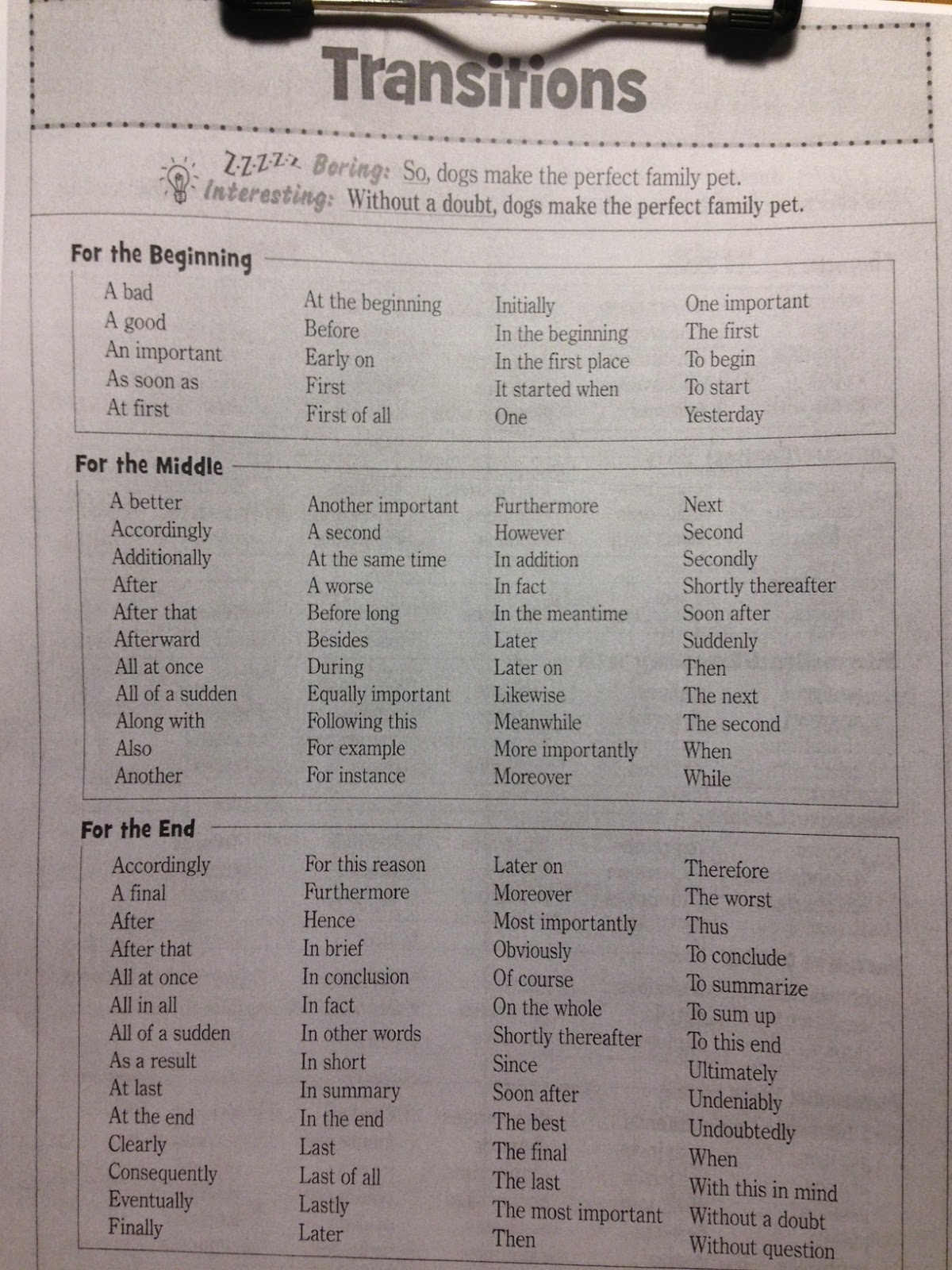
Transitions
Insert transition words & phrases to make your writing flow better.


2nd - Editing
Use the Peer Editing checklist, along with the help of your writing partner to edit your essay. 

How will your writing be evaluated?

1. Use the rubric to make final revisions to your writing, based on the traits that will be evaluated? 
2. Make sure your writing meets the expectations that are required for Mastering Level writing?
  • You will know you got it when...you and your writing partner both agree that your writing meets the mastering level criteria. 
  • You should both be able to rate each writing trait as "Mastering level."
Congratulations! You are now ready to begin the final publication process. Be sure to Include a proper heading. 
Assignment = Harry Potter Analytical Essay

Do's & Don't's for your Essay

Do...
  • Change Font Size to 14
  • Give your essay a title
  • Use "Tab" to indent each new paragraph.
  • Save your work frequently. The first time you save your essay, be sure to save it in your folder, and title it, "Harry Potter Analytical Essay"

Do not... 
  • Change the Font type
  • Use the space bar or tab key to center the title
  • Use the "Return" key at the end of the line. The computer will automatically scroll down to the next line for you. 
  • Spend time talking to a friend. Remember you are in the lab to type!!!

Remember your writing goals

Base Writing (5 - 7 paragraphs)
  • Introduction paragraph
  • 1-2 paragraphs per Act
  • Conclusion paragraph
Advanced Writing (8 - 11 paragraphs)
  • Introduction Paragraph
  • 2 - 3 paragraphs per Act
  • Conclusion Paragraph
Expert Writing (12 Paragraphs)
  • Introduction
  • 1 paragraph per stage of the Hero's Journey
  • Conclusion

Homework: Finish Sumerian Inventions Crossword puzzle

Tuesday, January 19, 2016

Day #80 - 1/19/16 - Learning Stations - Writing a Conclusion to an Analytical Essay

Good Morning Sixth Graders,
          I hope you all had a wonderful long weekend. Today is an E day, so we will go to Music. 
Please...
  • Sharpen your pencils
  • Order your lunch
  • Check your mailbox
  • Get your Reading folder
                                     Thank you
                                     Mr. Trumble
Point to Ponder: Trivia Tuesday...You know what to do!!!

#1 Guided Reading (We do)
Using Cornell Notes to align the main character from your guided reading book with the hero's journey.
  • Objective = Aligning Two Texts
  • Write an essential question
  • Use the depth of knowledge stems to write a level 1, 2, & 3 question before reading.
  • Write notes about the main idea and key details while reading. 
    #2 Independent Reading & Word Work (You do)
    • Read: Finish reading the assigned pages 
    • Analyze: Record info about Main Idea & Key details. 
    • Word Work/Build Vocabulary: Add words from your Guided Reading book to your list of vocabulary words
    • Make 1 Frayer Model in your Reading Response Notebook
    #3 Social Studies (You do)
    • Read the Biographical essay about Martin Luther King Jr.
    • Use the Guided Notes to record Main Ideas and Key Details
    • Record 3 facts for each category
    #4 Work on Writing (You do)

    • Writing a conclusion

    ABOUT CONCLUSIONS

         Introductions and conclusions can be the most difficult parts of papers to write. While the body is often easier to write, it needs a frame around it. An introduction and conclusion frame your thoughts and bridge your ideas for the reader.
         Just as your introduction acts as a bridge that transports your readers from their own lives into the “place” of your analysis, your conclusion can provide a bridge to help your readers make the transition back to their daily lives. Such a conclusion will help them see why all your analysis and information should matter to them after they put the paper down.
         Your conclusion is your chance to have the last word on the subject. The conclusion allows you to have the final say on the issues you have raised in your paper, to synthesize your thoughts, to demonstrate the importance of your ideas, and to propel your reader to a new view of the subject. It is also your opportunity to make a good final impression and to end on a positive note.
         Your conclusion can go beyond the confines of the assignment. The conclusion pushes beyond the boundaries of the prompt and allows you to consider broader issues, make new connections, and elaborate on the significance of your findings.
         Your conclusion should make your readers glad they read your paper. Your conclusion gives your reader something to take away that will help them see things differently or appreciate your topic in personally relevant ways. It can suggest broader implications that will not only interest your reader, but also enrich your reader’s life in some way. It is your gift to the reader.

    STRATEGIES FOR WRITING AN EFFECTIVE CONCLUSION

    One or more of the following strategies may help you write an effective conclusion.
    • Play the “So What” Game. If you’re stuck and feel like your conclusion isn’t saying anything new or interesting, ask a friend to read it with you. Whenever you make a statement from your conclusion, ask the friend to say, “So what?” or “Why should anybody care?” Then ponder that question and answer it.
      You can also use this strategy on your own, asking yourself “So What?” as you develop your ideas or your draft.
    • Synthesize, don’t summarize: Include a brief summary of the paper’s main points, but don’t simply repeat things that were in your paper. Instead, show your reader how the points you made and the support and examples you used fit together. Pull it all together. Why is your analysis important to your reader?
    • Propose a course of action, or questions for further Inquiry. This can redirect your reader’s thought process and help her to apply your info and ideas to her own life or to see the broader implications. For example, how does your analysis apply to other stories, novels, and movies.

    STRATEGIES TO AVOID

    • Beginning with an unnecessary, overused phrase such as “in conclusion,” “in summary,” or “in closing.” Although these phrases can work in speeches, they come across as wooden and trite in writing.
    • Introducing a new idea or subtopic in your conclusion.
    • Ending with a rephrased thesis statement.
    • Making sentimental, emotional appeals that are out of character with the rest of an analytical paper.
    • Including evidence (quotations, statistics, etc.) that should be in the body of the paper.

    One KIND OF INEFFECTIVE CONCLUSION

    1. The “That’s My Story and I’m Sticking to It” Conclusion.(Also known as "Now you know.")
      This conclusion just restates the thesis and is usually painfully short. It does not push the ideas forward. People write this kind of conclusion when they can’t think of anything else to say. Example: In conclusion, Frederick Douglass was, as we have seen, a pioneer in American education.
    Conclusions should:
    • Link your conclusion to your introduction
    • Reflect on your thesis
    • Why does your analysis matter to the reader?
    • Recommend a course of action or a new way of thinking.
    • Answer the question, "So what?"
    How will your writing be evaluated?
    Base Writing (5 - 7 paragraphs)
    • Introduction paragraph
    • 1-2 paragraphs per Act
    • Conclusion paragraph
    Advanced Writing (8 - 11 paragraphs)
    • Introduction Paragraph
    • 2 - 3 paragraphs per Act
    • Conclusion Paragraph
    Expert Writing (12 Paragraphs)
    • Introduction
    • 1 paragraph per stage of the Hero's Journey
    • Conclusion
    Analytical Essay 
    (One type of Pattern for your Writing)
    • 1. Intro sentence
      • Ex: Harry Potter receives a call to adventure.
      • Ex: Harry has allies and helpers that assist him along the Hero's Journey.
      • Ex: Harry has to face a road of trials throughout the story. 
    • 2. Sentence describing the stage of the Hero's Journey.
      • Ex: According to the Hero's Journey....
      • Ex: In this stage of the Hero's Journey...
    • 3. Sentence about your detail
      • Ex:
    • 4. Sentence explaining your evidence
      • In the text it says...
      • In the novel...
      • In the book...
      • According to the Author...
    • 5. Sentence connecting your detail and evidence. 
      • Ex: This shows...
      • Ex: This evidence proves...
      • Ex: This demonstrates how...


    #5 Computer - Open Ed
    • Step 1: Under the LINKS tab, click on the open ed link
    • Step 2: Choose one of the activities to try or one of the videos to watch. 
    • Step 3: Be sure you complete each assignment to the best of your ability. Review your answers and work to raise your score to 100% Mastery.
    • Step 4: Before signing out of "OpenEd" check your "Mastery List". 

        Homework: Finish conclusion to your analytical essay.

        Friday, January 15, 2016

        Day #79- 1/15/16 - Writing a Persuasive Essay and an Analytical Essay

        Good Morning Sixth Graders,
                 Today is a D day, so we will go to Library. We will also be having a character Education Assembly this morning, so be sure to put your best self forward today. Let's make it a fabulous Friday.
        Please...
        • Sharpen your pencils
        • Order your lunch
        • Check your mailbox
        • Get your Writing folder
                                             Thank you
                                             Mr. Trumble
        Point to Ponder: Share your introductions to your persuasive essays with the people at your table. Get some feedback from your group members. Check for:
        1. Hook
        2. Introduce yourself  
        3. Tell why your topic is important
        4. Thesis (I believe statement)
        Activity #1
        Persuasive Writing with Mrs. Isham


        Activity #2

        Harry Potter & the Chamber of Secrets
        Analyzing and Evaluating Harry Potter as a model of the Hero's Journey
        • Today I will use my graphic organizer to draft body paragraphs analyzing and evaluating literature, so that I can prove Harry Potter fits the pattern of the Hero's Journey. 


        How will your writing be evaluated?

        1. What writing traits will be evaluated? 
        2. What writing expectations are you required to demonstrate to reach the Mastering Level?

        I will know I got it when...(See Rubric)
        Base Writing (5 - 7 paragraphs)
        • Introduction paragraph
        • 1-2 paragraphs per Act
        • Conclusion paragraph
        Advanced Writing (8 - 11 paragraphs)
        • Introduction Paragraph
        • 2 - 3 paragraphs per Act
        • Conclusion Paragraph
        Expert Writing (12 Paragraphs)
        • Introduction
        • 1 paragraph per stage of the Hero's Journey
        • Conclusion
        Analytical Essay 
        (One type of Pattern for your Writing)
        • 1. Intro sentence
          • Ex: Harry Potter receives a call to adventure.
          • Ex: Harry has allies and helpers that assist him along the Hero's Journey.
          • Ex: Harry has to face the road of trials throughout the story. 
        • 2. Sentence describing the stage of the Hero's Journey.
          • Ex: According to the Hero's Journey....
          • Ex: In this stage of the Hero's Journey...
        • 3. Sentence about your detail
          • Ex:
          • Ex:
        • 4. Sentence explaining your evidence
          • In the text it says...
          • In the novel...
          • In the book...
          • According to the Author...
        • 5. Sentence connecting your detail and evidence. 
          • Ex: This shows...
          • Ex: This evidence proves...
          • Ex: This demonstrates how...


        While you are writing I will be holding writing conferences to discuss your progress.

        Homework:

        Thursday, January 14, 2016

        Day #78 - Learning Stations - Drafting an Analytical Persuasive Essay

        Good Morning Sixth Graders,
                  I hope you all stayed warm out there. Today is a C day, so we will go to Gym. 
        Please...
        • Sharpen your pencils
        • Order your lunch
        • Check your mailbox
        • Get your Reading folder
                                             Thank you
                                             Mr. Trumble
        Point to Ponder: Take out your Social Studies homework and share your answers with the people at your group. Make sure you have written complete sentences and have answered every question as thoroughly as you can. Compare the words you unscrambled on page 3 of the packet.

        #1 Guided Reading (We do)
        Using Cornell Notes to align the main character from your guided reading book with the hero's journey.
        • Objective = Aligning Two Texts
        • Write an essential question
        • Use the depth of knowledge stems to write a level 1, 2, & 3 question before reading.
        • Write notes about the main idea and key details while reading. 
          #2 Independent Reading (You do)
          • Read: Finish reading the assigned pages 
          • Build Vocabulary: Add words from your Guided Reading book to your list of vocabulary words
          • Main Idea & Key details. 
          #3 Word Work (You do)
          • Read the informational essay titled "The Development of Writing."
          • Use card stock & your cuneiform alphabet to create a name tent for yourself.
          • You may scribe your first or last name, or both. 
            • Be neat. 
            • Write as large as you can to fill the space. I want to be able to read your name from the front of the class. 
            • Use pencil first, then go over your name in sharpie marker.
          • If you finish, you can scribe (in cuneiform) one of the chapter 5 vocabulary words on page 102 - 119. 

          #4 Work on Writing (You do)
          • Today I will use my graphic organizer to draft body paragraphs analyzing and evaluating literature, so that I can prove Harry Potter fits the pattern of the Hero's Journey. 


          • How will your writing be evaluated?
            Base Writing (5 - 7 paragraphs)
            • Introduction paragraph
            • 1-2 paragraphs per Act
            • Conclusion paragraph

            Advanced Writing (8 - 11 paragraphs)
            • Introduction Paragraph
            • 2 - 3 paragraphs per Act
            • Conclusion Paragraph

            Expert Writing (12 Paragraphs)
            • Introduction
            • 1 paragraph per stage of the Hero's Journey
            • Conclusion

            Analytical Essay 
            (One type of Pattern for your Writing)
          • 1. Intro sentence
            • Ex: Harry Potter receives a call to adventure.
            • Ex: Harry has allies and helpers that assist him along the Hero's Journey.
            • Ex: Harry has to face a road of trials throughout the story. 
          • 2. Sentence describing the stage of the Hero's Journey.
            • Ex: According to the Hero's Journey....
            • Ex: In this stage of the Hero's Journey...
          • 3. Sentence about your detail
            • Ex:
          • 4. Sentence explaining your evidence
            • In the text it says...
            • In the novel...
            • In the book...
            • According to the Author...
          • 5. Sentence connecting your detail and evidence. 
            • Ex: This shows...
            • Ex: This evidence proves...
            • Ex: This demonstrates how...


          #5 Computer - Open Ed
          • Step 1: Under the LINKS tab, click on the open ed link
          • Step 2: Choose one of the activities to try or one of the videos to watch. 
          • Step 3: Be sure you complete each assignment to the best of your ability. Review your answers and work to raise your score to 100% Mastery.
          • Step 4: Before signing out of "OpenEd" check your "Mastery List". 

            Homework: Finish a first draft for all Body Paragraphs. On Monday we will write Introductions & Conclusions. 

            Tuesday, January 12, 2016

            Day #77 - 1/12/16 - Writing a Persuasive Essay and an Analytical Essay

            Good Morning Sixth Graders,
                     Today is a B day, so we will go to Art. Let's make it a terrific Tuesday.
            Please...
            • Sharpen your pencils
            • Order your lunch
            • Check your mailbox
            • Get your Writing folder
                                                 Thank you
                                                 Mr. Trumble
            Point to Ponder: Trivia Tuesday. Pick up a Harry Potter trivia card and take turns asking and answering questions with people at your table.


            Activity #1
            Persuasive Writing with Mrs. Isham
            How to Write an Introduction to your Persuasive Essay

            Activity #2

            Harry Potter & the Chamber of Secrets
            Analyzing and Evaluating Harry Potter as a model of the Hero's Journey
            • Today I will use my graphic organizer to draft body paragraphs analyzing and evaluating literature, so that I can prove Harry Potter fits the pattern of the Hero's Journey. 


            How will your writing be evaluated?

            1. What writing traits will be evaluated? 
            2. What writing expectations are you required to demonstrate to reach the Mastering Level?

            I will know I got it when...(See Rubric)
            Base Writing (5 - 7 paragraphs)
            • Introduction paragraph
            • 1-2 paragraphs per Act
            • Conclusion paragraph
            Advanced Writing (8 - 11 paragraphs)
            • Introduction Paragraph
            • 2 - 3 paragraphs per Act
            • Conclusion Paragraph
            Expert Writing (12 Paragraphs)
            • Introduction
            • 1 paragraph per stage of the Hero's Journey
            • Conclusion
            Analytical Essay 
            (One type of Pattern for your Writing)
            • 1. Intro sentence
              • Ex: Harry Potter receives a call to adventure.
              • Ex: Harry has allies and helpers that assist him along the Hero's Journey.
              • Ex: Harry has to face the road of trials throughout the story. 
            • 2. Sentence describing the stage of the Hero's Journey.
              • Ex: According to the Hero's Journey....
              • Ex: In this stage of the Hero's Journey...
            • 3. Sentence about your detail
              • Ex:
              • Ex:
            • 4. Sentence explaining your evidence
              • In the text it says...
              • In the novel...
              • In the book...
              • According to the Author...
            • 5. Sentence connecting your detail and evidence. 
              • Ex: This shows...
              • Ex: This evidence proves...
              • Ex: This demonstrates how...


            While you are writing I will be holding writing conferences to discuss your progress.

            Homework:
            • First Drafts Must be done by Friday!!!
            • Cuneiform Writing Packet


            Monday, January 11, 2016

            Day #76 - 1/11/16 - Learning Stations

            Good Morning Sixth Graders,
                      I hope you all had a very fun weekend. Today is an A day, so we will go to Gym. 
            Please...
            • Sharpen your pencils
            • Order your lunch
            • Check your mailbox
            • Get your Reading folder
                                                 Thank you
                                                 Mr. Trumble
            Point to Ponder: Trivia Day - Pick up a Harry Potter Trivia card and take turns asking and answering questions.

            #1 Guided Reading (We do)
            Using Cornell Notes to align the main character from your guided reading book with the hero's journey.
            • Objective = Aligning Two Texts
            • Write an essential question
            • Use the depth of knowledge stems to write a level 1, 2, & 3 question before reading.
            • Write notes about the main idea and key details while reading. 
              #2 Independent Reading (You do)
              • Read: Finish reading the assigned pages 
              • Build Vocabulary: Add words from your Guided Reading book to your list of vocabulary words
              • Main Idea & Key details. 
              #3 Word Work (You do)
              • Hammurabi's Law Code
              • Read the informational text about Hammurabi's Lawcode.
              • Highlight main ideas and key details.
              • Write the Gist in the margin of each section.
              • Preview the questions. 
              • There will be a quiz tomorrow.
              #4 Work on Writing (You do)
              • Today I will continue to use my graphic organizer to draft body paragraphs analyzing and evaluating literature, so that I can prove Harry Potter fits the pattern of the Hero's Journey. 


                • How will your writing be evaluated?
                  Base Writing (5 - 7 paragraphs)
                  • Introduction paragraph
                  • 1-2 paragraphs per Act
                  • Conclusion paragraph


                  Advanced Writing (8 - 11 paragraphs)
                  • Introduction Paragraph
                  • 2 - 3 paragraphs per Act
                  • Conclusion Paragraph


                  Expert Writing (12 Paragraphs)
                  • Introduction
                  • 1 paragraph per stage of the Hero's Journey
                  • Conclusion

                  Analytical Essay 
                  (One type of Pattern for your Writing)
                • 1. Intro sentence
                  • Ex: Harry Potter receives a call to adventure.
                  • Ex: Harry has allies and helpers that assist him along the Hero's Journey.
                  • Ex: Harry has to face a road of trials throughout the story. 
                • 2. Sentence describing the stage of the Hero's Journey.
                  • Ex: According to the Hero's Journey....
                  • Ex: In this stage of the Hero's Journey...
                • 3. Sentence about your detail
                  • Ex:
                  • Ex:
                  • Ex:
                • 4. Sentence explaining your evidence
                  • In the text it says...
                  • In the novel...
                  • In the book...
                  • According to the Author...
                • 5. Sentence connecting your detail and evidence. 
                  • Ex: This shows...
                  • Ex: This evidence proves...
                  • Ex: This demonstrates how...


              #5 Computer - Open Ed
              • Step 1: Under the LINKS tab, click on the open ed link
              • Step 2: Choose one of the activities to try or one of the videos to watch. 
              • Step 3: Be sure you complete each assignment to the best of your ability. Review your answers and work to raise your score to 100% Mastery.
              • Step 4: Before signing out of "OpenEd" check your "Mastery List". On the sticky note please write down 
                • (1) Your assessment average
                • (2) How many assessments you have mastered?

                Homework: Review for Quiz on Hammurabi's Code