APW Elementary

APW Elementary
Rebel Pride Starts Inside

Tuesday, October 10, 2017

Day 24: 10/10/17 - D Day: Identifying Mood, Tone, & Theme - Christian the Lion

Good Morning 6th Graders,
          Today is a 'D' Day. Make sure you use the bathroom & sharpen your pencils. Check to see that you have everything you need for your morning classes. 
                                Thank you
                                Mr. Trumble
ELA:
Do Now:
  • Write tonight's homework down in your agenda
  • Pick up a Theme Tree & a list of Thematic topics. 
  • Glue in the Theme Tree on the very next page in your ELA Notebook
Homework: 
  • Complete Theme, Mood, & Tone Worksheets

Activity #1
Identifying Theme
Standards 
  • RL6.2 Determine a theme, and how it is conveyed through particular details. 

Many people confuse "Theme" & "Subject"


Difference Between a Theme and a Subject

It is important not to confuse a theme of a literary work with its subject. Subject is a topic that acts as a foundation for a literary work, while a theme is an opinion expressed on the subject. For example, a writer may choose a subject of war for his story, and the theme may be his personal opinion that war is a curse for humanity. Usually, it is up to the readers to explore the theme of a literary work by analyzing characters, plot, and other literary elements.

Directions: 
Watch Christian the Lion
1. Write the details/text evidence from the video on the leaves.
2. Write the topics on the trunk.
3. Connect the topics with the details to determine the theme.


Notes
  • An idea or subject in a literary work
  • Recurs throughout the piece of literature
  • Statement that provides an insight into how the world works
  • Is bigger than the characters in the story
  • An idea you can apply to your own life

Activity #2
Identifying Mood & Tone
Standard:
  • RL6.4 Analyze the impact of specific word choice on meaning & tone

Key Question:
What is the difference between the mood of a text and the tone of a text

Mood:
  • Reader Centered
  • Influenced by the Setting
  • The overall feeling, or atmosphere, created by a work of literature
Tone:
  • Writer Centered
  • The attitude a writer takes towards the subject or the reader


Now it's your turn...

Work with a partner of your own choosing to complete the following practice worksheets.


RTI - D day
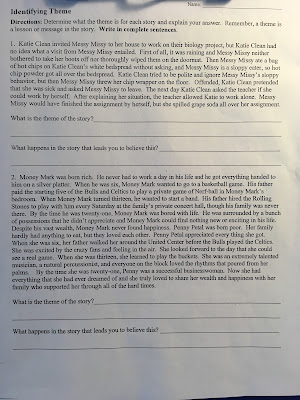
Identifying Theme, Mood, & Tone
Standards 
  • RL6.2 Determine a theme, and how it is conveyed through particular details. 
  • RL6.4 Analyze the impact of specific word choice on meaning & tone

Directions:
  1. Today we will be working in small groups to practice identifying the style, tone, mood, and theme
    • Group 1 - Miss W.
    • Group 2 - Mr. T
Work with your small group to complete the practice worksheets.


Friday, October 6, 2017

Day 23: 10/6/17 - C Day: Identifying Conflicts within a Text, Plot Lines, & FTM Ch 22 & 23

Good Morning 6th Graders,
          Today is a 'C' Day. Make sure you use the bathroom & sharpen your pencils. Check to see that you have everything you need for your morning classes. 
                                Thank you
                                Mr. Trumble

ELA:
Do Now:
  • Write tonight's homework down in your agenda
  • Pick up a "What Type of Conflict" Worksheet and preview it independently
Homework: 
  • Finish reading FTM Ch 22 & 23 
  • Complete Cornell Notes 


Activity #1
Individual Work
Identifying Conflicts
STANDARDS:
  • RL6.1 - Cite textual evidence to support analysis of what the text says explicitly as well as inferences drawn from the text.
Directions:
Part 1 - You must work independently to answer questions 1 - 6. Write the type of conflict on the line provided. 

Remember:
"Person vs Person" is the same thing as "Man vs Man"
"Person vs Nature" is the same thing as "Man vs Nature"
"Person vs Society" is the same thing as "Man vs Society"
"Person vs Self" is the same thing as "Man vs Self"

Part 2 - Write an example of each type of conflict from the text. Then write a citation, (or a piece of evidence) that supports your example.

When you are done you may pick up a copy of the Cornell Notes for chapter 22 & 23 and begin working on them until everyone is done.

Essential Question: What questions do I have about ch 22 & 23 plot events and what conflicts can I identify?

  1. While you read it is important to annotate what you are reading. (6-8 Annotations)
  2. Use your D.O.K. Stems to help you generate level 1, 2, & 3 questions. (Minimum of 3 questions)
  3. Finish with a 3 - 4 sentence summary.


Activity #2
Small Group Work
Plot Lines
Standards:
  • RL6.3 - Describe how a particular story's plot unfolds in a series of episodes as well as how characters respond or change as the plot moves toward a resolution

Directions:
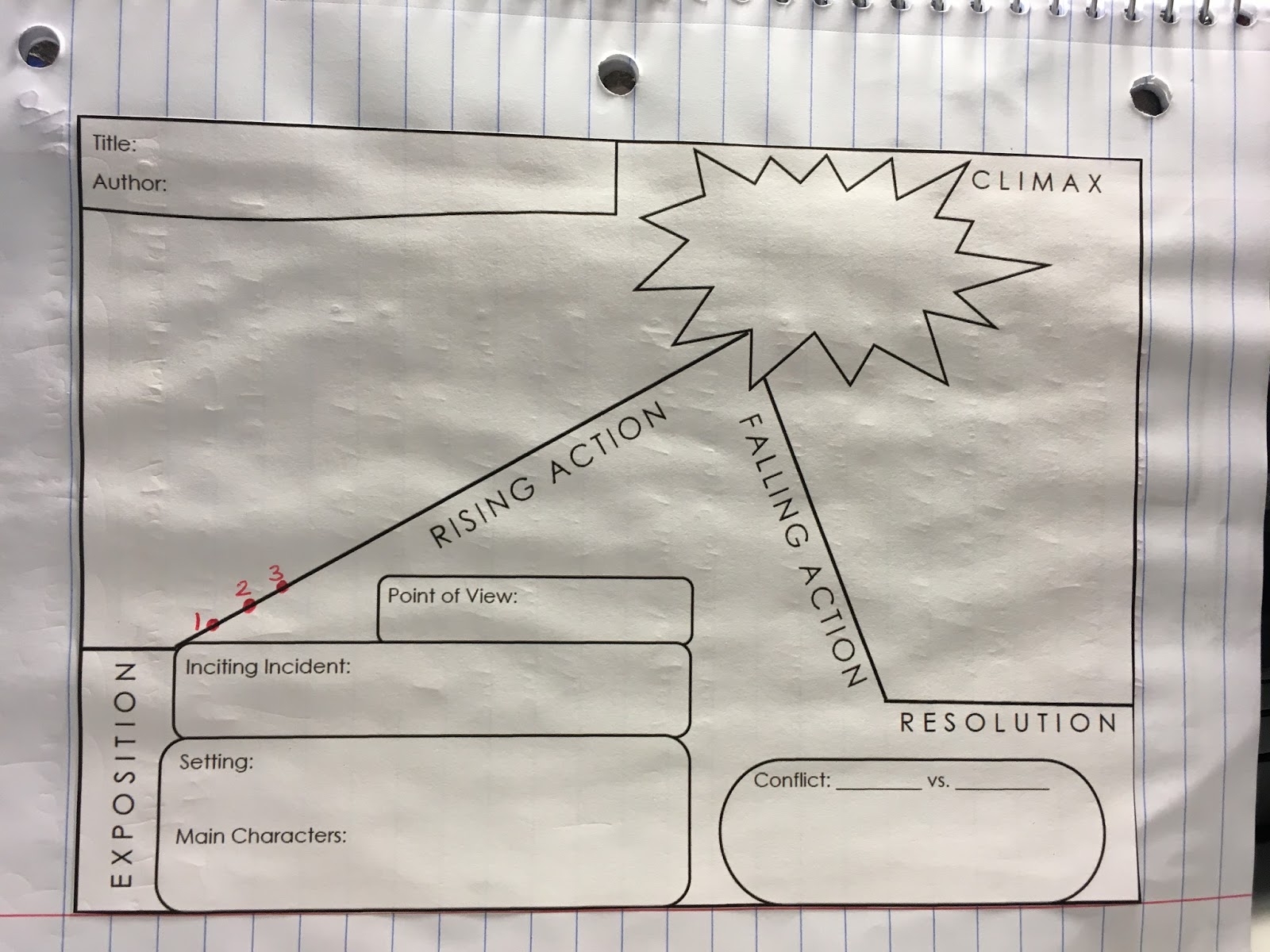
Work with your small group to fill in the plot line with the appropriate information from Freak the Mighty.
Fill in:
  • Exposition
  • Inciting Incident
  • Rising action (about 1 events per chapter: 12 events in all) 
  • Climax
If students are finished they may begin on their Cornell notes for chapters 22 & 23

Activity #3
Reading - Small Group
Freak the Mighty: Chapters 22 & 23

Standards
  • RL6.1 - Making Inferences and using evidence to support your thinking
  • RL6.3 - Describe how a story, or plot, unfolds in a series of events, including how the characters respond or change

Reading Strategies: Annotating a Text, Questioning & Summarizing

Directions:
  1. While you read it is important to annotate what you are reading. (6-8 Annotations)
  2. Use your D.O.K. Stems to help you generate level 1, 2, & 3 questions. (Minimum of 3 questions)
  3. Finish with a 3 - 4 sentence summary.
Annotations should be about the following:

  1. Figurative Language
  2. Characterization
  3. Setting
  4. Plot Events
  5. Conflicts
RTI - C day
Read Aloud
Freak the Mighty: Chapters 22 & 23

Standards
  • RL6.1 - Making Inferences and using evidence to support your thinking
  • RL6.3 - Describe how a story, or plot, unfolds in a series of events, including how the characters respond or change

Reading Strategies: Annotating a Text, Questioning & Summarizing

Directions:
  1. While you read it is important to annotate what you are reading. (6-8 Annotations)
  2. Use your D.O.K. Stems to help you generate level 1, 2, & 3 questions. (Minimum of 3 questions)
  3. Finish with a 3 - 4 sentence summary.
Annotations should be about the following:
  1. Figurative Language
  2. Characterization
  3. Setting
  4. Plot Events
  5. Conflicts

Thursday, October 5, 2017

Day 22: 10/5/17 - B Day: Kidblogging about Conflicts in Freak the Mighty, & Ch 21

Good Morning 6th Graders,
          Today is a 'B' Day. Make sure you use the bathroom & sharpen your pencils. Check to see that you have everything you need for your morning classes. 
                                Thank you
                                Mr. Trumble
ELA:
Do Now:
  • Write your homework down in your agenda
  • Pick up your Cornell Notes & set them up for tonight's homework

Homework: 
  • Read Ch 21 of FTM & Complete Cornell Notes
    • Focus on writing level 1, 2, & 3 questions & identifying conflicts

Activity #1
Set up Cornell Notes for Tonights Reading

Essential Question: What questions do I have about ch 21 plot events and what conflicts/resolutions can I identify?


Activity #2
Kidblog
Use Technology to 
Create a Written Response to a Text 

Standards:
RL6.1 - Cite textual evidence to support analysis of what the text says explicitly as well as inferences drawn from the text
W6.4 - Produce clear and coherent writing in which the development, organization, and style are appropriate to task, purpose, and audience.
W6.6 - Use technology including the internet, to produce and publish writing as well as to interact and collaborate with others; demonstrate sufficient command of keyboarding skills

Computer Lab Directions

Part 1: Logging in to Kidblog
1. Log into the computer using your login and password
2. Use Chrome & go to our classroom website
www.roytrumble.blogspot.com
3. Click on the link for ELA Kidblog
3. In the upper right hand corner click on the Log in icon.
4. Scroll down to find your name. They are listed by your first name and the first initial in your last name.
5. Your password is 6 characters long. It is your last name. If your last name is only 5 characters long, then it is followed by a number 1. If it is 4 characters long it is followed by the numbers 12.
6. Once you enter your password, it will ask you to create a new password. Create a password that is easy to remember. You will need to write your password down in your agenda for safe keeping.
7. Finish logging in to gain full access to kidblog

Part 2: Creating a Blog Post
Answers should be a well developed paragraph with:

Writing Prompt:
One conflict in the novel is a man vs. man conflict between Max and his father Kenny Kane. This conflict is resolved in the events of chapter 19 & 20 during the climax. Describe in detail the events of the climax. Include any inferences that you may have made about these events, or about Max and Kevin.


Bonus Writing Prompt:
Include:
  • an introduction
  • details
  • evidence
  • Reflection
  • Identify a conflict that Max or Kevin are dealing with in the novel Freak the Mighty.
  • Describe how the author develops the conflict throughout the text.
  • Use evidence from the text to support your thinking.
  • Reflect on how the author either resolves this conflict, or how you think the author should resolve the conflict.

********************************
You must publish a post before the end of class. I will be scoring your written responses. If you finish you may create a second post about another conflict, or respond to other people's posts. Be sure to write everything in complete sentences!
********************************
1. To create a new post click on the blue icon for New Post+ in the upper right corner.
2. Give your post a title.
10. In the text box type your post, answering the question,  Provide evidence from the text to support your thinking.
11. Be sure to use proper grammar and mechanics, including capitals and punctuation.
12. When you are done responding to the prompt, click on the blue Publish icon.
13. When prompted you may publish your response to the "Class"
14. If you finish you may go back to the homepage of kidblog and you may respond to other student's posts with a question or a comment.


RTI -10/5/17 - B day
Freak the Mighty - Ch 21
Small group Reading & Reading Closely
Cornell Notes
GROUP #1 - Mr. Trumble
GROUP #2 - Miss W.
  • What questions did you write for Chapter 19 & 20?
  • What level were those questions?
  • What types of conflicts have you been able to identify for Max & Kevin?
  • How were these conflicts resolved?
Standards
RL6.1 - Cite Textual evidence to support analysis of what the text says explicitly as well as inferences drawn from the text.

RL6.3 Describe how a particular story's plot unfolds in a series of events as well as how the character responds or changes as the plot moves toward a resolution.

Reading Strategies - 
Annotating
Questioning
Summarizing

Questioning and summarizing helps us make strong inferences about what we are reading


Wednesday, October 4, 2017

Day 21: 10/4/17 - A Day: The 4 Types of Conflict & Freak the Mighty Ch 19 & 20

Good Morning 6th Graders,
          Today is an 'A' Day. Make sure you use the bathroom & sharpen your pencils. Check to see that you have everything you need for your morning classes. 
                              Thank you
                                Mr. Trumble
ELA:
Do Now: 
  • Place
     your HW on your desk so I can check it
  • Write tonight's homework down in your agenda
  • Pick up a copy of the Types of Conflict and color code it.(See my example)
Homework: 
  • Finish reading Ch 19 & 20
  • Complete the Cornell Notes
    • Focus on asking level 1, 2, # 3 Questions & on identifying the types of conflicts the Max and Kevin are going through


Activity #1
The 4 Types of Conflict
Step 1: Label each type of Conflict
Step 2: Cut out and Glue in the 4 types of conflict to form a square
Step 3: Write the definition for each type of conflict

10/4 Conflict

There are 4 Types of Conflict
    • 1 Internal
    • 3 External


1. Man vs. Man (External)
  • A struggle, mental or physical, between two characters
  • usually between the Protagonist and an antagonist

2. Man vs. Nature (External)
  • A struggle between a character and mother nature
  • Mother nature = weather, animals, sickness, etc

3. Man vs. Society (External)
  • A struggle between a character & the laws or beliefs of a group
  • could involve poverty, politics, social norms, expectations, etc

4. Man vs. Self (Internal)
  • A struggle between a character and his feelings, conscience, or fear
Activity #2
Read Aloud
Freak the Mighty: Chapters 19 & 20
But First... Finish adding the events to the rising action portion of your plot lines.


Standards
RL6.1 - Making Inferences and using evidence to support your thinking
RL6.3 - Describe how a story, or plot, unfolds in a series of events, including how the characters respond or change

Reading Strategy - Annotating a Text & Summarizing
While you read it is important to annotate what you are reading. This will allow you to comprehend what you are reading and make more accurate inferences about the reading.
  1. Figurative Language
  2. Characterization
  3. Setting
  4. Plot
  5. Themes
  6. Conflicts
Before reading: (Small Group)
Key Questions from Chapter 18
  • Summarize Ch 18(Small Group)
  • What questions did you write about Ch 18? (Small group)
  • What types of conflicts can you identify in this chapter?
Essential Question: What questions do I have about ch 19 & 20 plot events and what conflicts can I identify?
RTI - A day
Read Aloud
Freak the Mighty: Chapters 19 & 20

  • What questions did you write for Chapter 18?
  • What level were those questions?
  • What types of conflicts have you been able to identify for Max & Kevin?
Standards
RL6.1 - Making Inferences and using evidence to support your thinking
RL6.3 - Describe how a story, or plot, unfolds in a series of events, including how the characters respond or change

Reading Strategies - 
Annotating a Text, Summarizing, & Questioning

While you read it is important to annotate what you are reading. This will allow you to comprehend what you are reading and make more accurate inferences about the reading.
  1. Figurative Language
  2. Characterization
  3. Setting
  4. Plot
  5. Themes
  6. Conflicts

Tuesday, October 3, 2017

Day 20: 10/3/17 - D Day: Internal vs. External Conflict & Freak the Mighty Ch 18

Good Morning 6th Graders,
          Today is a 'D' Day. Make sure you use the bathroom & sharpen your pencils. Check to see that you have everything you need for your morning classes. 
                                Thank you
                                Mr. Trumble
ELA:
Do Now:
  • Place your HW on your desk so I can check to see that it is done.
  • Write tonight's homework down in your agenda
  • Pick up a copy of Internal vs External Conflict & Color Code it. (See my example)
Homework: 
  • Finish reading Ch 18
  • Complete the Cornell Notes
    • Focus on asking level 1, 2, # 3 Questions & on identifying the types of conflicts the Max and Kevin are going through


Activity #1
Internal Vs. External Conflict
  • RL6.2 Determine a Central Idea of a text and how it is conveyed through details
10/3 Conflict
Conflict = a struggle between opposing forces or characters
  • without conflict the story would be Boring
  • Conflicts can be internal or external
  • A story can have several conflicts
  • the main conflict is central to the plot & is usually resolved at the resolution
What are some examples of internal Conflicts?
What are some examples of external Conflicts?


Activity #2
Read Aloud
Freak the Mighty: Chapters 18

Standards
RL6.1 - Making Inferences and using evidence to support your thinking
RL6.3 - Describe how a story, or plot, unfolds in a series of events, including how the characters respond or change

Reading Strategy - Annotating a Text & Summarizing
While you read it is important to annotate what you are reading. This will allow you to comprehend what you are reading and make more accurate inferences about the reading.
  1. Figurative Language
  2. Characterization
  3. Setting
  4. Plot
  5. Themes
  6. Conflicts
Key Questions from Chapter 17
  • Summarize Ch 17 (Small Group)
  • What questions did you write about Ch 17? (Small group)
  • Infer how Iggy got the apartment for Kenny Kane?
  • Do you think Max's dad really sent him letters and gifts from prison?
  • Do you think Max's dad actually killed Annie? What evidence from the text can you use to support your thinking?
  • What types of conflicts can you identify in this chapter?

Essential Question: What inferences and questions do I have about the Characters & the important Plot events of Freak the Mighty?

RTI - D day
Read Aloud
Freak the Mighty: Chapters 18

GROUP #1 - Mr. Trumble
GROUP #2 - Miss W.
  • What questions did you write for Chapter 17?
  • What level were those questions?
  • What types of conflicts have you been able to identify for Max & Kevin?

Standards
RL6.1 - Making Inferences and using evidence to support your thinking
RL6.3 - Describe how a story, or plot, unfolds in a series of events, including how the characters respond or change

Reading Strategies - 
Annotating a Text, Summarizing, & Questioning

While you read it is important to annotate what you are reading. This will allow you to comprehend what you are reading and make more accurate inferences about the reading.
  1. Figurative Language
  2. Characterization
  3. Setting
  4. Plot
  5. Themes
  6. Conflicts
  • What questions did you write for Chapter 17?
  • What level were those questions?
  • What types of conflicts have you been able to identify for Max & Kevin?

Monday, October 2, 2017

Day 19: 10/2/17 - C Day: Quiz on Ch 11 - 15, Freak the Mighty Ch 17, & Using DOK Questions

Good Morning 6th Graders,
          Today is a 'C' Day. Make sure you use the bathroom & sharpen your pencils. Check to see that you have everything you need for your morning classes. 
                                Thank you
                                Mr. Trumble
ELA:
Do Now:
  • Place your Written Response HW in the Red Bin
  • Write tonight's homework down in your agenda
  • Pick up a Book Order Form (Due 10/12)
Homework: 
  • Finish reading and annotating Ch 17
  • Complete Cornell Notes Using DOK Questions to write a level 1, 2 & 3 question
Activity #1
Quick Comprehension Check
AKA: a Quiz
Standards: (Look them up in your ELA Notebook to see which standards I will be evaluating)
  • RL6.4
  • W6.4
  • RL6.3

Directions:
Vocabulary: Questions 1 - 4: Be sure to write the letter of your answer choice on the line provided (1 point each)


Short Answer:  Answer in complete sentences and use evidence from the text. (4 Points each)

Matching:  Be sure to write the letter of your answer choice on the line provided (1 point each)

*If you finish you may pick up a set of Cornell Notes and begin working on Chapter 17


Essential Question: What inferences can I make about the Characters & the important Plot events of Freak the Mighty?

Activity #2
Group Discussion Using your D.O.K. Stems
& Plot Lines
RL6.1 - Cite textual evidence to support analysis of what the text says explicitly as well as inferences drawn from the text
RL6.2 - Determine a theme of a text and how it is conveyed through particular details, provide a summary of the text distinct from personal opinions.
RL6.3 - Describe how a particular story's plot unfolds in a series of events as well as how the characters respond or change as the plot moves toward resolution. 

Ch16
  1. Can you summarize the events of Ch. 16
    1. What questions did you write down?
    2. What level was that question?
My Questions:
  1. Pg 101 - What is your opinion of Max's father's words?"I know what they told ya. It's all a big lie, you understand. I never killed anybody, and that's the truth, so help me god."Do you believe Max's father? 
  2. Pg 103 - How does the narrators word choice and description of Christmas Eve on page 103 affect the mood and tone?
  3.  Pg 107 - How would yo u react to the events of the evening?
Fill in the Rising Action of your Plot Lines

RTI - C day
Read Aloud
Freak the Mighty: Chapters 17

Standards
RL6.1 - Making Inferences and using evidence to support your thinking
RL6.3 - Describe how a story, or plot, unfolds in a series of events, including how the characters respond or change

Reading Strategies - Annotating a Text, Summarizing & Questioning
  1. What questions can you write down?
  2. What level question did you write?

While you read it is important to annotate what you are reading. This will allow you to comprehend what you are reading and make more accurate inferences about the reading.
  1. Figurative Language
  2. Characterization
  3. Setting
  4. Plot
  5. Themes
  6. Conflicts