
Homeroom:
Good Morning. Please use this time to get ready for your day.
Do Now:
- Check that your homework is done
- Make sure you have all your materials
- Sharpen pencils
E.L.A. Learning Target:
Today you will write a thesis statement, and use your gathering information graphic organizers to begin outlining your persuasive essay.
Do Now:
- Write down your independent work
- Take out your Gathering Info Graphic Organizers
- Pick up a copy of the Persuasive Essay Outline
- Open your notebooks to Page 38
Independent work:
- Work on the Persuasive Essay Outline (Due Tuesday 1/20)
Activity #1
Writing a Persuasive Essay
5. Write a thesis Statement
Now that we have gathered information for our topic we can write a thesis statement.

Thesis statement = Your Opinion. This is your "I think, I believe, I feel," statement.
***Be sure to include a brief explanation of 'why'. This is where you will input your 3 reasons you will expand on in your essay.
Ex:
I believe that all elementary students should receive at least 30 minutes of recess every day, because they will be able to be more attentive, more productive, perform better, and be more well-behaved in class.
***Be sure to include a brief explanation of 'why'. This is where you will input your 3 reasons you will expand on in your essay.
Ex:
I believe that all elementary students should receive at least 30 minutes of recess every day, because they will be able to be more attentive, more productive, perform better, and be more well-behaved in class.
6. Outlining
Use the Writing a Persuasive Essay Checklist along with the Outline to begin planning your essay. REMEMBER, THE OUTLINE IS JUST THAT, AN OUTLINE. IT IS NOT THE PAPER ITSELF. YOU WILL BE USING YOR OUTLINE TO THEN WRITE WELL STRUCTURED PARAGRAPHS.
To Complete the Outline:
- Start with the Thesis
- Then put in your 3 reasons (From your thesis)
- Go from beginning to end
- Use Bullets
- You may skip parts and come back to them later
- Be sure to include your sources
- According to__________...
- Research from__________ proves...
- Data from___________ shows...
- __________ reports that...
- You do not need to write in complete sentences


7. Drafting
- USE YOR OUTLINE TO WRITE WELL STRUCTURED PARAGRAPHS. LET THE CHECKLIST BE YOUR GUIDE. YOU CAN SEE THAT YOU WILL NEED 6 PARAGRAPHS!
- I WILL MODEL HOW TO GET STARTED!
- You May Write on line paper, but I would highly encourage you to complete your draft in a Google Document. That way we can save it along the way, so then editing & revising will be easier.
- Drafting should take us about 2 days
Drafting - Paragraphs 1, 2, & 3
Drafting - Paragraphs 4, 5, & 6


8. Editing & Revising
Editing & Revising - Phase 1
- Independent - Use the checklist in your notebook
- Make sure that you have all required parts
- Make sure you have enough sentences in each part
- Make sure you have included your sources
Editing & Revising - Phase 2
- Partner - Use the checklist in your notebook & repeat the process with a writing partner
- Repeat the process again with another writing partner
- Partners job is to help make the paper better

- Check spelling
- Check Grammar
- Did you vary your sentence structure? (Short, medium, long)
- Did you use conjunctions to make compound sentences? (And, but, or)
- Elaboration - Have you elaborated on all your ideas to be specific about your ideas?
- Does your introduction have a hook, background info, and a strong specific thesis statement with 2 parts?
- What transition words did you use?
- Where can you add transition words?
- Did you clarify vocabulary words?
Body Paragraph 1 - 3:
Conclusion:- Do your body paragraphs clearly state your reasons?
- Do they have Evidence?
- Have you elaborated and explained your evidence in detail?
- Have you included your sources?
- Is there a link connecting your evidence to your reason?
- What transition words did you use?
- Where can you add transition words?
- Did you clarify vocabulary words?
Body Paragraph 4:
- Did you present the opposing side of the issue?
- Did you use language like: I know, I understand, I am aware...
- Have you elaborated and explained the opposing side of the issue in detail?
- Did you refute or Rebut?
- Did you explain in detail why the opposing side of the issue should think like you?
- What transition words did you use?
- Where can you add transition words?
- Did you clarify vocabulary words?
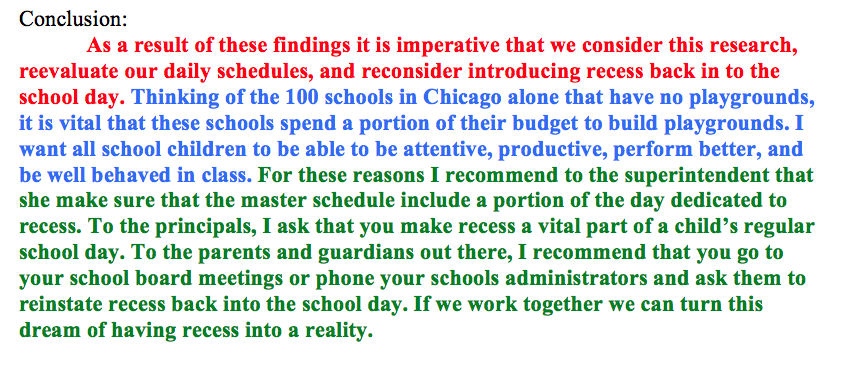
- Does your conclusion include a reflection, Connection, and recommendations?
- What transition words did you use?
- Where can you add transition words?
- Who did you make recommendations too?
- What did you recommend?
- Did you include a "bow" on top, or finish with a strong statement?


Have a great day!

No comments:
Post a Comment